)

While summer typically coaxes global markets into a quiet, predictable rhythm, this July has been anything but restful. Between major geopolitical power plays in the Strait of Hormuz and a relentless race for AI dominance, it seems that everybody wants to rule the world.
We dive straight into how equity markets are managing to shrug off geopolitical heat to keep pushing forward, even as bond markets face a volatile storm of surging oil prices and central bank transitions. Finally, discover how our own balanced portfolios navigated this shifting landscape to deliver a net return of +3.12% through July 31st 2026, outperforming our benchmark.
Enjoy the read.
Table of Contents
The market at a glance: Everybody wants to rule the world
Song of the month: “Everybody wants to rule the world” by Tears for Fears
Summer is in full swing, mails are getting answered by moderately funny “out of office” message, and this usually is also accompanied with the well-known “summer lull” on global markets. Everyone is on their best behaviour, and so are the markets.
Not so much this year however: from the football World Cup to serious topics like the war in Iran, delegations from all over the world were contending to showcase who would rule over the world for the upcoming years. Whilst Spain might have settled the debate on the football field, the delegations in and around the Strait of Hormuz are nowhere near a resolution, and markets felt the impact.
Key takeaways
The Strait of Hormuz, which everybody wants to rule
Equity markets shrugged off the tensions and kept climbing, carried by lasting AI enthusiasm, another race a few players intend to win outright
Everywhere else, from bonds to commodities to digital assets, volatility crept back into the picture
What happened with equities
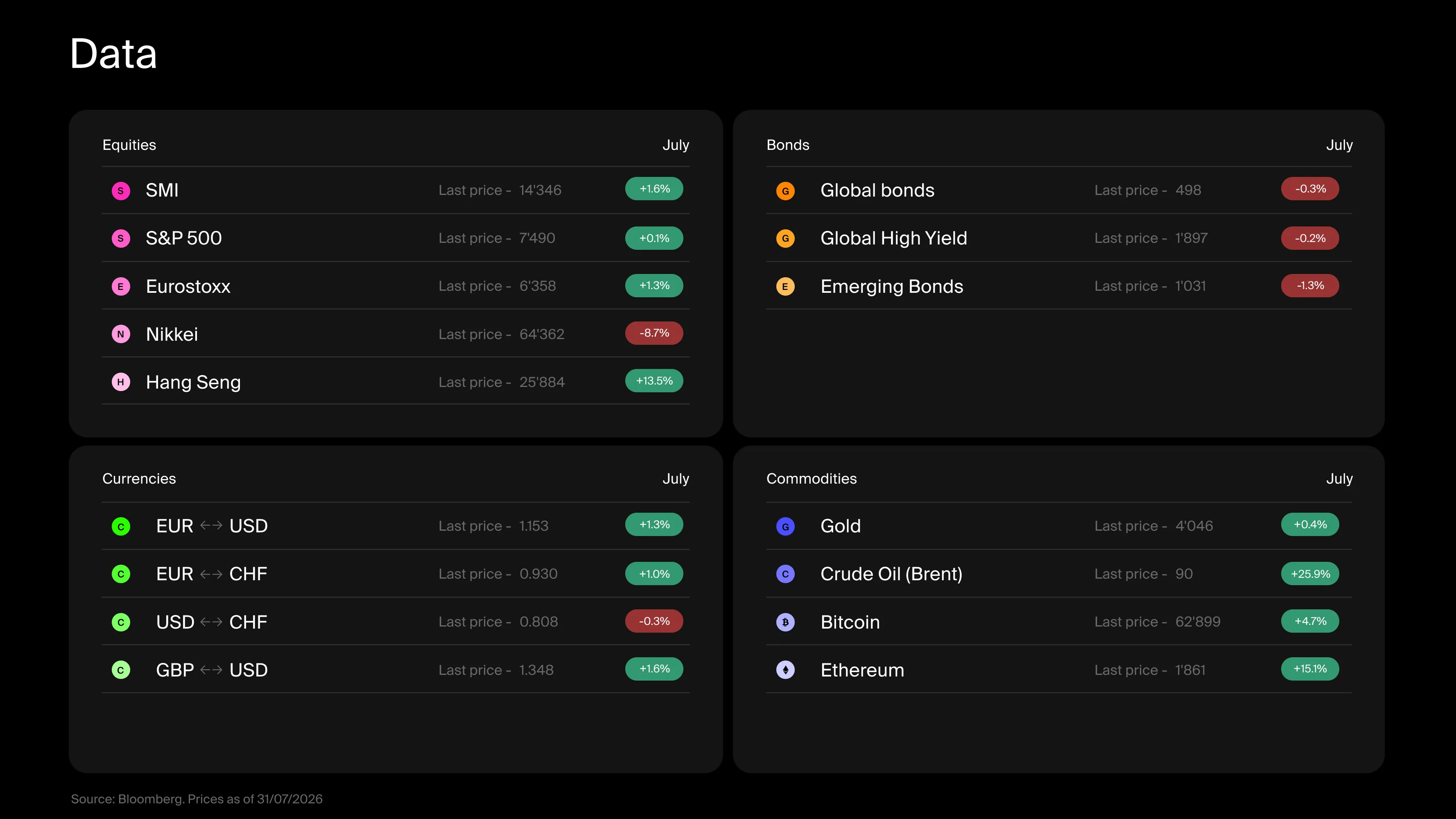
Equity markets ended July broadly flat. In the US, markets continued to rise, buoyed by ongoing enthusiasm for artificial intelligence. Caution is warranted, however: valuations in the technology sector are now very high, and historically, valuations at these levels have weighed on future returns.
A similar pattern played out in Europe and Asia, with inflationary tendencies clouding the picture. Instability in the Middle East, combined with a highly awaited earnings season, produced a slight dip mid-month. Talk about holding hands while the walls come tumbling down.
What happened with bonds
The bond market spent July looking anxiously at the horizon as geopolitical tremors in the Middle East hardened into stubborn macroeconomic realities. A 26% surge in oil prices over the month reignited fears of a second wave of energy-driven inflation and pushed US Treasury yields steadily upward. The 10-year note hit an 18-month high of 4.71%, a far cry from the calmer ranges of spring.
On July 29th, the new Fed Chair kept interest rates unchanged and maintained the federal funds target range at 3.50% to 3.75%.
Across the Atlantic, the European Central Bank chose to play it safe. Having already acted preemptively in June with a 25-basis-point hike against exactly these energy risks, the Governing Council held its key rate steady at 2.25% on 23 July. Frankfurt is firmly in wait-and-see mode, refusing to commit to a preset rate path until it is clear how deeply the oil spike will bleed into core inflation.
For fixed-income investors, the message is plain: the era of policy inertia is over, and volatility is firmly back on the menu.
What happened with commodities, currencies, and digital assets
The global race to rule the world, or at least the Strait of Hormuz, left its mark on commodity prices. The resumption of hostilities between Iran and the United States shattered the memorandum of understanding the two parties signed on 17 June and became one of the main drivers of volatility in financial markets. After several weeks of calm and announced talks on safe passage through the strait, strikes, retaliation and traded threats reignited investors' concerns. One question hangs over it all: if the strait reopens as a toll passage, the economic and political implications would be significant, and other states bordering strategically important straits and canals might start getting ideas of their own.
Cryptocurrencies, meanwhile, had a positive month. Bitcoin climbed and most altcoins followed. The pattern looks driven not only by AI optimism spilling over from equity markets, but also by a run to perceived safety from investors wary of a potential bubble bursting.
Everyone wants to rule the world, and the markets are being dragged into the race. At times it can feel as if we are merely bystanders. But that is precisely the reminder to keep adapting our portfolios and strategies, to personal needs as much as to global macro events. Nothing lasts forever, and even the direst conflicts eventually resolve.
)
Alpian: Our portfolio performance: +3.12% YTD
Markets have had a hard 2026 so far, swinging between fear of capital losses and the opportunity cost of staying on the sidelines.
In a world where everybody wants to rule, managing wealth can feel like a high-wire act. The first seven months of 2026 tested even seasoned investors, torn between the fear of sudden drops and the nagging anxiety of missing the AI rally.
Through it all, our active portfolios kept their stride. In the year to 31 July 2026, Alpian's discretionary Balanced Portfolios delivered an average net return of +3.12%, slightly outperforming our benchmark, the Performance Watcher Mid-Risk Index, which stood at +2.91%.*
This outperformance came with slightly higher volatility: 7.52% for Alpian compared with 6.40% for the benchmark.
Building a financial strategy is not about chasing short-term hype. It is about creating a robust, personal design that stands the test of time.
Have questions about your investment strategy? Our wealth advisors are here to help.
*Performance of the Alpian Balanced Portfolio compared with the PW Mid-Risk Index (31 December 2025 to 31 July 2026). The average performance of Swiss banks for a balanced strategy is represented by the Performance Watcher Mid-Risk Index. For Alpian, we display the average performance of all types of discretionary portfolios following a balanced strategy (between 40 and 60% equity allocation). All performance figures reflect the aggregate time-weighted return, net of fees, across all Alpian clients with a balanced strategy. Individual investment results may vary due to factors such as investment timing and specific strategy choices. Past performance is not indicative of future results. The content of this publication is provided for informational purposes only and should not be interpreted as legal, tax, investment, financial, or other professional advice.
Performance should always be assessed together with risk. Performance Watcher adjusts returns for volatility and compares the resulting risk-adjusted performance with that of the benchmark.
Investments involve risks, including the possible loss of invested capital. The value of investments can fluctuate and there is no guarantee of making profits or avoiding losses. Diversification does not ensure a profit or protect against a loss. Potential investors should consult a qualified financial advisor before making any investment decisions. Please read the full risk warnings and other relevant documents on our website before investing.


)

)

)